Stiffness with a constraint.
Structural bracket optimisation
A steel support bracket studied across geometry, mass, deformation and safety factor, with the selected design checked again in FEA.
Establish the baseline
I set up a static structural model with a 2 mm mesh and local refinement near the holes. The baseline study reported 0.52844 mm maximum deformation, 304.7 MPa equivalent stress and a minimum safety factor of 1.2057.
Explore the design space
A 15-point Design of Experiments varied stiffener thickness, width and height. I examined response surfaces, sensitivity and goodness of fit before using multi-objective optimisation to explore the trade-off between mass, stiffness and safety.
Verify the chosen candidate
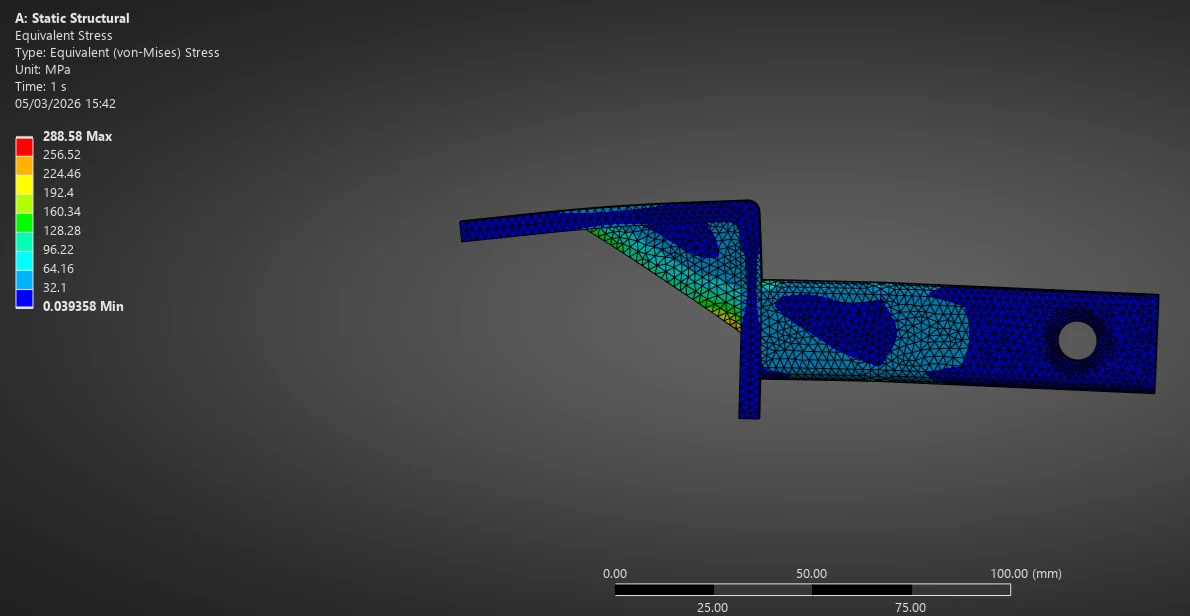
A fresh FEA solution for the selected candidate reported 0.40194 mm deformation, 288.58 MPa equivalent stress and a minimum safety factor of 1.3194 at approximately 0.4006 kg. The improvement in stiffness came with a small increase in mass.
Keep the result in context
The design targets were 0.4 kg, 0.4 mm deformation and a safety factor of 1.3. The verified candidate came close to the mass and deformation targets and exceeded the safety-factor target. These results apply to the modelled material, load and boundary conditions; a surrogate prediction alone was not treated as final verification.
1 / 7 · Select image to enlarge
Baseline bracket geometry before meshing.
Project evidence: Finite Element Analysis report dated 12 March 2026 and original ANSYS outputs. All performance figures are simulation results.
Small experiments. Clearer decisions.